

As an investment property owner in the Los Angeles area, maintenance costs are unavoidable. Appliances fail, plumbing leaks, roofs wear out, and heating and cooling systems require service. Smaller expenses, such as filters, pest control, landscaping, and painting, also add up over time.
New state requirements, tighter local enforcement, and rising repair costs also mean that maintenance is no longer just about fixing what breaks. It is about protecting your investment, reducing risk, and retaining reliable and high-quality tenants long-term.
This guide on rental property maintenance for Los Angeles-area landlords covers:
- What rental property maintenance typically includes
- How much to budget for maintenance
- The importance of preventative maintenance
- Key maintenance-related compliance rules LA-area landlords need to know.
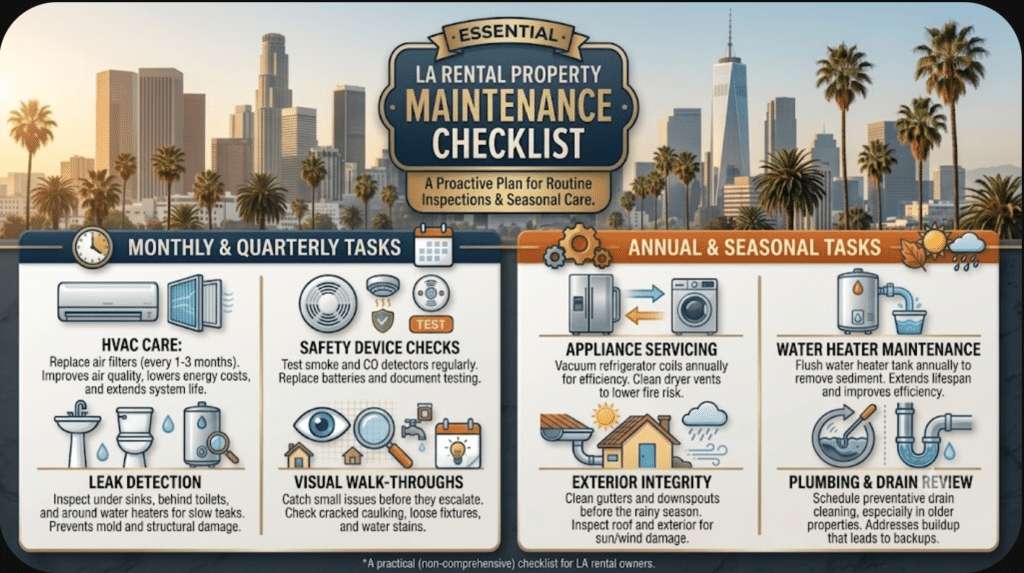
Maintenance Is No Longer an Expense. It Is ROI Protection.
Many rental property owners still view maintenance as a necessary expense rather than a strategic investment. In reality, proactive maintenance protects your return on investment by preventing emergency repairs, extending the lifespan of major systems, and reducing tenant turnover.
Letting problems linger often leads to larger problems. A small leak becomes mold remediation. A neglected HVAC system fails during peak summer heat. A faulty appliance turns into a habitability violation. Each of these issues costs significantly more when handled reactively.
What Does Los Angeles Rental Property Maintenance Include?
Rental property maintenance covers the routine work, repairs, and replacements needed to keep a property safe and habitable. Common expenses include:
- Plumbing and electrical repairs
- HVAC service and filter replacement
- Appliance maintenance and replacement
- Pest control and landscaping
- Interior and exterior painting
- Roof and gutter maintenance
- Flooring repairs and replacement
- Cleaning and make-ready work between tenants
Landlords should also plan for capital expenditures (CapEx). These are larger, less frequent costs such as replacing a roof, HVAC system, water heater, electrical panel, or major appliance. Routine maintenance keeps a property operating day to day. A capital reserve prepares an owner for the eventual and inevitable replacement of major systems.
Why Budgeting for Property Maintenance Matters
Rental income is not the same as profit. Owners need to account for taxes, insurance, vacancy, management, and repair costs before arriving at actual cash flow.
Without a plan and budget for maintenance, a single major repair to your investment property can consume months of income and eat away at profit. A $6,000 HVAC replacement, for example, can offset several months of rent on a typical LA County property.
Deferred maintenance also tends to compound. A plumbing leak that costs $150 to fix early can turn into $2,000–$5,000 in drywall and flooring damage if left unaddressed, and an unserviced HVAC system that fails during extreme heat often requires emergency repairs priced 20–30% above scheduled service.
How Much Should LA Landlords Budget for Maintenance?
There is no single formula that fits every property. The methods below are common starting points. The right number for a given building depends on its age, condition, and maintenance history.
1. Percentage-of-Rent Method
A common guideline is setting aside 5–10% of monthly rent.
| Monthly Rent | 5% Reserve | 10% Reserve |
| $2,500 | $125/month | $250/month |
Older properties, or those with deferred maintenance, may warrant 10–15%, particularly if major systems are near the end of their lifespan.
2. Square-Footage Method
Budget $1–$2 per square foot annually.
- 1,200 sq ft home → $1,200–$2,400/year → roughly $100–$200/month
Larger properties or multi-unit buildings tend to fall toward the higher end.
3. Property-Value Method
Some owners budget 1% of property value per year.
- $700,000 property → $7,000/year → about $583/month
Note that in the Los Angeles area, property value is often driven heavily by land and location, which doesn’t necessarily reflect the condition of the plumbing, roof, electrical system, or appliances. These formulas are useful starting points, not substitutes for an inspection and actual repair history.
Factors That Affect LA Rental Maintenance Costs
Two properties with similar rents can have very different maintenance needs, depending on:
- Age and condition — older buildings across LA County, including areas like Baldwin Park and Burbank, may have aging pipes, wiring, roofing, or appliances. Actual condition matters more than location alone.
- Number of units — multifamily buildings involve more fixtures, appliances, and tenant requests, plus shared systems like parking areas, stairways, and exterior lighting.
- Tenant turnover — each vacancy typically requires cleaning, painting, flooring work, lock changes, and inspections.
- Local labor and permit costs — professional repairs involve labor, materials, permits, and inspections, all of which should be built into a budget.
Preventive Maintenance Reduces Long-Term Costs
Preventive maintenance means inspecting and servicing systems before they fail. This is often the least expensive way to handle a repair.
- Plumbing and drains: Watch for running toilets, dripping faucets, slow drains, low pressure, or rising water bills. Periodic inspections and drain cleaning can catch aging pipes before they cause major damage.
- HVAC: Southern California temperature swings put heavy demand on heating and cooling systems. Routine service and filter changes can catch worn components early.
- Roof and gutters: Dry weather can weaken roofing materials, and sudden rain can expose cracks or drainage issues. Annual inspections help prevent leaks.
- Water heaters: Check regularly for leaks, corrosion, and sediment buildup to extend equipment life.
- Electrical systems: Tripped breakers, flickering lights, warm outlets, or burning odors warrant prompt professional attention, especially in older systems not designed for modern electrical loads.
When Landlords Should Avoid DIY Repairs
Cosmetic touch-ups may be reasonable to handle personally, but safety-related or complex work is generally better left to licensed professionals. A failed DIY repair can cost more than the original problem and may create safety hazards, code violations, or insurance complications.
Use particular caution with:
- Electrical repairs
- Hidden or recurring plumbing leaks
- Water-heater problems
- Roof and structural repairs
- Complex appliance repairs (many now include electronic, water, or gas connections)
- Any work requiring permits or inspections
Organizing a Maintenance Budget for Your Rental Property
It can help to separate maintenance funds into distinct categories:
- Routine maintenance — filters, landscaping, pest control, cleaning, minor repairs
- Preventive maintenance — inspections, HVAC tune-ups, roof evaluations, plumbing and water-heater service
- Capital expenses — roof, HVAC, plumbing, electrical panel, flooring, and appliance replacements
- Emergency repairs — a separate cushion for unexpected leaks, equipment failures, or storm damage
Rental Property Maintenance As Legal Compliance in LA
Maintenance and compliance overlap more than many owners expect. Several habitability and safety rules are, in effect, maintenance requirements with legal weight behind them. Falling behind on either one carries real financial and legal risk, including fines, lawsuits, and difficulty enforcing lease terms.
Statewide Habitability Requirements
California Civil Code Section 1941 and related statutes require landlords to maintain rental units in a livable condition. This generally includes:
- Functioning plumbing, gas, heating, and electrical systems
- Weatherproofing and structural integrity (walls, windows, roof)
- Working smoke detectors and carbon monoxide detectors where applicable
- Adequate trash receptacles and pest-free conditions
- Hot and cold running water
Failure to maintain habitable conditions can expose landlords to rent withholding, repair-and-deduct claims, or habitability lawsuits.
New in 2026 — stove and refrigerator requirement (AB 628): As of January 1, 2026, AB 628 amended Civil Code Section 1941.1 to add a working stove/oven and working refrigerator to the list of features required for a unit to be legally tenantable.
Safety and Disclosure Requirements
Depending on the property, landlords may need to comply with:
- Smoke and carbon monoxide detector installation and maintenance requirements
- Water heater seismic strapping
- Mold and lead-based paint disclosures (for pre-1978 buildings)
- Bedbug disclosure requirements
- Local rental registration or business license requirements
Local Habitability Enforcement in Los Angeles
Beyond the state-level standard, LA-area landlords are subject to local inspection and enforcement programs, which vary by jurisdiction.
City of Los Angeles
- Systematic Code Enforcement Program (SCEP): The Los Angeles Housing Department (LAHD) inspects rental buildings with two or more units on a rotating cycle, roughly once every four years. Owners and tenants are notified at least 30 days before a scheduled inspection, and inspectors check items such as smoke and carbon monoxide detectors, water heater strapping, window screens, and plumbing leaks.
- Rent Escrow Account Program (REAP): If violations aren’t corrected within the compliance timeline, a property can be referred to REAP, and the owner may also be referred to the City Attorney’s office. Under REAP, tenants pay rent into a city-managed account instead of to the owner until the violations are resolved.
- E3 exterior elevated element inspections: For qualifying buildings, balconies, decks, and similar elevated elements required a safety inspection by January 1, 2026, and every six years thereafter, with ongoing maintenance remaining the owner’s responsibility.
Unincorporated Los Angeles County
- The Rental Housing Habitability Program (RHHP), established by County ordinances enacted in April 2024, created a separate rental inspection program for unincorporated areas of LA County, distinct from the City’s SCEP.
- A related 82°F indoor cooling mandate applies in these areas as well, requiring rentals to maintain indoor temperatures at or below that threshold. The rule is being phased in as tenants gained the right to install portable air conditioning units starting September 2025, with evaluation during RHHP inspections beginning in 2025 and full enforcement expected by 2027.
Other LA County Cities
Cities such as Burbank and Baldwin Park generally run their own code enforcement and may have local rental inspection, registration, or licensing requirements separate from the City of LA’s SCEP or the County’s RHHP.
Owners with properties in these cities should confirm current requirements directly with each city’s housing or code enforcement department, since programs and deadlines are not uniform countywide.
Because habitability standards are legal requirements, not optional upgrades, compliance-related repairs (a broken heater, a safety hazard, a failed smoke detector) generally need to be prioritized over discretionary or cosmetic work.
Building compliance checks into a regular maintenance schedule, rather than addressing them reactively, tends to reduce both legal exposure and repair costs over time.
*Disclaimer: This information is for educational purposes and does not constitute legal advice. Rental maintenance in Los Angeles is governed by both California state law and the LA City Rent Stabilization Ordinance (RSO). Requirements for habitability, emergency repairs, and newer 2026 mandates are subject to change. Because penalties for non-compliance in the City of Los Angeles can be severe, always consult with a qualified attorney or the LAHD (Los Angeles Housing Department) before taking action.
Keeping Accurate Property Maintenance Records
Maintaining records of inspections, invoices, warranties, permits, tenant requests, and completed repairs helps landlords:
- Track recurring problems
- Monitor the age of major systems
- Plan future replacements
- Support insurance or warranty claims
- Evaluate actual operating costs
Maintenance history, over time, tends to be a more reliable budgeting guide than any general formula.
Are Repairs to Rental Properties Tax-Deductible?
Ordinary repair and maintenance expenses may be deductible in the year they occur, while improvements and major replacements are typically depreciated over time. The distinction depends on whether the work maintains the property or materially improves/extends its life. The IRS publishes guidance on rental expenses, repairs, and depreciation. Landlords should keep receipts and consult a qualified tax professional when classifying expenses.
Good Property Maintenance Supports Tenant Retention
Prompt, well-communicated maintenance affects both tenant experience and long-term property condition. Tenants are more likely to renew when repair requests are acknowledged and addressed in a reasonable timeframe, even if the work can’t be completed immediately. Repeated delays can erode trust and contribute to turnover, which carries its own costs in vacancy, advertising, cleaning, and re-leasing.
Why Professional Maintenance Management Matters More Than Ever
DIY maintenance may seem cost-effective, but mistakes are expensive. Improper repairs, delayed responses, or missing documentation can expose owners to fines, lawsuits, or lost rent.
Professional property management ensures compliance with evolving regulations, controls repair costs through vetted vendors, and protects owners from unnecessary liability.
In a city as regulated as Los Angeles, maintenance is not just operational. It is legal risk management.
Do not wait for a code violation or a midnight emergency to discover your maintenance plan is outdated.
Contact Lotus Property Services for a Free Property Assessment.
Frequently Asked Questions About LA Rental Property Maintenance
How much should a landlord budget for maintenance each month? Most guidelines suggest 5–10% of monthly rent, $1–$2 per square foot annually, or about 1% of property value per year, with older or higher-maintenance properties trending toward the higher end of each range.
What’s the difference between routine maintenance and capital expenses? Routine maintenance covers recurring, lower-cost items (filters, landscaping, minor repairs). Capital expenses are larger, less frequent replacements of major systems, such as a roof or HVAC unit.
What happens if a landlord doesn’t maintain habitability standards? Unaddressed habitability issues can lead to rent withholding, repair-and-deduct claims, code enforcement action, or lawsuits, in addition to tenant turnover.
Does the City of Los Angeles inspect rental properties for habitability? Yes. Buildings with two or more units are inspected on a rotating cycle (roughly every four years) under the Systematic Code Enforcement Program (SCEP). Uncorrected violations can lead to a REAP referral, where tenants pay rent into a city-managed account instead of to the owner.
Are landlords required to provide a stove and refrigerator in California? Yes, as of January 1, 2026. AB 628 added a working stove and refrigerator to the state’s habitability standard for leases entered into, amended, or renewed on or after that date.
This article provides general information for Los Angeles County rental property owners and is not a substitute for professional legal, tax, or maintenance advice specific to your property.