

Modern tenants in cities like Los Angeles are accustomed to managing nearly every part of their lives online. They pay utility bills, schedule appointments, order groceries, invest, get rides, and find places to live from their phones. It makes sense that they increasingly expect the same convenience from their rental experience.
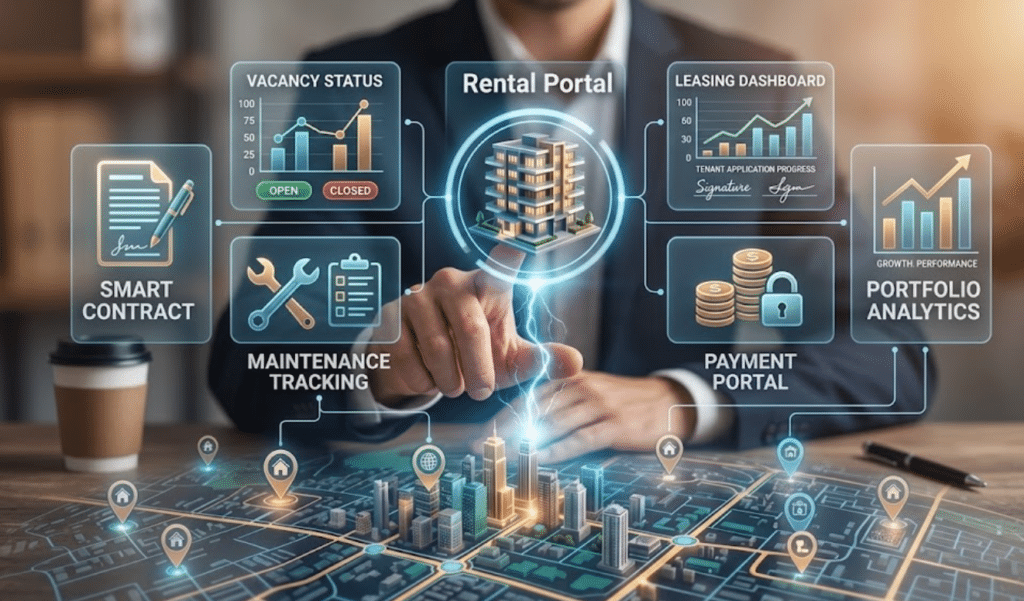
For Greater Los Angeles landlords, an online portal to manage their rental properties offers much more than convenience. It can:
- Automate rent collection
- Improve tenant communication
- Document crucial information
- Protect investment property cash flow
- Create a more professional rental operation
For owners managing several properties, it can also make growing your portfolio far easier.
Here are some of the biggest reasons an online portal has become essential for real estate investors and landlords in Los Angeles trying to reduce stress, maximize income, and grow their business.
1. Makes Rent Collection Easier and More Predictable
Rent collection, of course, is one of the most important responsibilities of any landlord, but casual payment apps can create unnecessary complications.
While tools like Venmo, Cash App, or Zelle seem convenient, they quickly become difficult to manage when trying to track multiple tenants and properties. They don’t automatically sync with tenant records, and they lack built-in tools to block partial payments during lease disputes. Additionally, sorting through individual app feeds makes bookkeeping messy.
At Lotus Property Services, our extensive online portal for rental properties creates a centralized, hassle-free system for rent payment, plus offers the granular management sophistication required by serious investors.
Tenants can pay rent using ACH transfers, debit cards, or credit cards directly from a computer or smartphone. Many portals also allow tenants to enroll in automatic payments.
Auto-pay helps reduce missed or late rent payments by allowing tenants to schedule their rent to be paid on the same date each month. Automated reminders provide an additional prompt before rent is due.
The landlord benefits as well. Instead of sorting through payment app transactions, manually updating spreadsheets, or checking bank deposits against tenant records, payments automatically appear in the tenant’s ledger.
That means rental property owners can quickly see:
- Which tenants have paid
- Which balances remain outstanding
- When payments were submitted
Moving beyond basic payment apps to an online portal leads to more consistent rent collection and predictable cash flow, making it easier for landlords to budget for mortgages, repairs, insurance, taxes, and other operating expenses.
2. Creates a Better System for Maintenance Requests
Rental property maintenance, especially in Los Angeles, is another area where informal property management systems can quickly create expensive problems.
Imagine receiving a text message from a resident saying, “The sink is leaking.” The message may not explain how serious the leak is, where it is located, or whether there is visible damage. The landlord may have to send several follow-up texts before even knowing which vendor to contact.
An online portal for your rental property creates a much clearer process.
Tenants can submit a formal maintenance request and provide details about the problem. Many systems also allow tenants to upload photos or videos showing the issue.
That additional information can help a landlord or property manager determine the urgency of the repair and send the appropriate vendor the first time.
More importantly, digital maintenance requests create a time-stamped history of the issue.
The original request, communication with the tenant, vendor assignment, repair progress, and completion date can all remain connected to the same maintenance ticket.
Staying on top of maintenance is more than good customer service. The Los Angeles Housing Department requires rental property owners to maintain their properties to meet habitability requirements. A portal can help landlords respond more efficiently by creating a clear record of when a repair was reported, what action was taken, and when the work was completed.
Learn about AB 628 and SB 610 and the inclusion of working refrigerators and stoves as mandatory for habitability: Los Angeles Appliance Law
3. Keep Documents and Communication in One Place
Rental properties generate a surprising amount of paperwork.
There are leases, addendums, inspection reports, notices, pet agreements, move-in checklists, move-out documentation, payment histories, and other records that may need to be referenced months or even years later.
When documents are stored in different email accounts, filing cabinets, desktop folders, and text-message threads, finding the right information can become frustrating.
An online tenant portal can function as a central source of truth for the landlord-tenant relationship.
Tenants can log in and access their lease, review important policies, check payment history, or locate other relevant documents without contacting the landlord.
That type of self-service access offered by online portals can reduce routine questions such as:
“When does my lease expire?”
“How much did I pay last month?”
“What does my lease say about pets?”
Instead of waiting for the landlord to respond, tenants may be able to find the information themselves.
The result is fewer interruptions for the property owner and a more convenient experience for the tenant. This 24/7 self-service capability serves as an important benefit of portal-based property management.
4. Improves the Tenant Experience and Encourages Renewals
Technology alone will not make someone a great landlord. Properties still need to be maintained, questions need to be answered, and tenant concerns need to be taken seriously.
However, a good online portal can make those responsibilities easier to manage.
Tenants generally appreciate simple processes. Paying rent should not require coordinating a meeting with a landlord. Reporting a broken appliance should not involve wondering whether a text message was received. Finding a copy of a lease should not require waiting until business hours.
Convenience contributes to the overall rental experience.
When tenants can easily pay rent, request repairs, communicate with management, and access important information, the property will feel more professionally managed.
That matters because tenant turnover can be expensive.
When a resident moves out, owners may face cleaning costs, repairs, advertising expenses, leasing costs, vacancy periods, and lost rent. Keeping a qualified tenant for another lease term can therefore have significant financial value.
An online portal cannot guarantee a renewal, but it can remove some of the frustrations that make the rental experience unnecessarily difficult.
5. Gives LA Landlords Better Financial Visibility
Landlords need to know more than whether rent was paid.
They also need a clear understanding of how the property is performing financially.
A quality online portal can help rental property owners track income, expenses, outstanding balances, maintenance costs, and other operational information from a single platform.
Rather than collecting information from multiple spreadsheets and bank accounts, owners may be able to generate reports on demand.
This can be particularly useful during tax season or when reviewing the performance of an investment property.
Real-time financial reporting allows landlords to make better-informed decisions.
An owner who sees maintenance costs steadily increasing, for example, may decide that replacing an aging system makes more financial sense than continuing to repair it. Another owner may use year-over-year financial reports to evaluate whether operating expenses are rising faster than rental income.
The goal is not simply better bookkeeping. It is having the information necessary to manage the property as an investment.
6. Protects Sensitive Information
Rental property management in Los Angeles involves a significant amount of sensitive information.
Tenant applications, contact information, payment records, leases, banking details, and other documents all need to be handled carefully. When those records are scattered across personal email accounts, paper files, text messages, or unsecured spreadsheets, landlords may create unnecessary privacy and security risks.
A dedicated property portal offers a more controlled environment for storing and accessing important rental information. Password-protected accounts, defined user access, and centralized document storage can help limit who can access sensitive records while reducing the number of places where personal and financial information is stored.
Centralized access can also make it easier for landlords to maintain organized records without repeatedly sending sensitive documents through email or other less structured communication channels.
Of course, not every platform offers the same security features. Property owners should evaluate a provider’s security practices, access controls, and data-protection policies before choosing a system.
Still, using a secure, professionally managed portal can provide a more organized approach to protecting tenant and financial information than relying on disconnected files, personal devices, and multiple applications.
For landlords, that added layer of organization and control provides another important benefit: greater confidence that sensitive information is being handled thoughtfully as part of the overall property management process.
7. Makes It Easier to Scale Your Rental Portfolio
A landlord managing a single property may be able to track rent payments, repairs, and tenant communications using spreadsheets and a smartphone.
Add five properties, however, and those systems become much harder to maintain.
Adding 10, 20, or more units to a rental property portfolio can make the amount of administrative work overwhelming.
That is where the automation offered by an online portal becomes especially valuable.
An online portal creates repeatable systems for rent collection, maintenance requests, communication, documentation, and reporting. Instead of creating a new management process every time another property is added, the existing system can accommodate additional tenants and units.
Good systems allow landlords to spend less time reacting and more time managing their investments.
Modern Property Management Requires Modern Tools
An online portal is no longer simply a nice feature to offer renters. For many landlords, it has become an important part of operating rental property efficiently.
Lotus Property Services’ online portal helps rental property owners streamline operations while providing tenants with the convenient, professional experience today’s renters expect.
The right system can simplify rent collection, organize maintenance requests, improve documentation, centralize communication, provide clearer financial records, and create a better experience for tenants.
It can also give property owners something equally valuable: more time.
Self-managing landlords who find themselves constantly chasing payments, responding to routine questions, sorting through maintenance texts, or updating spreadsheets may have reached the point where their current system is costing them more than they realize.
Professional property management can take that technology one step further by combining modern online tools with experienced day-to-day management.
If managing your rental property is becoming more time-consuming than you anticipated, contact Lotus Property Services to learn how professional property management and our online portal can help protect your investment, maximize returns, and simplify your ownership experience.